Diamond Clarity: VVS vs VS vs SI — What Can You Actually See?
Published: 2026-03-31 | Author: Shopify API
Tags: 4Cs, diamond clarity, education, SI, VS, VVS
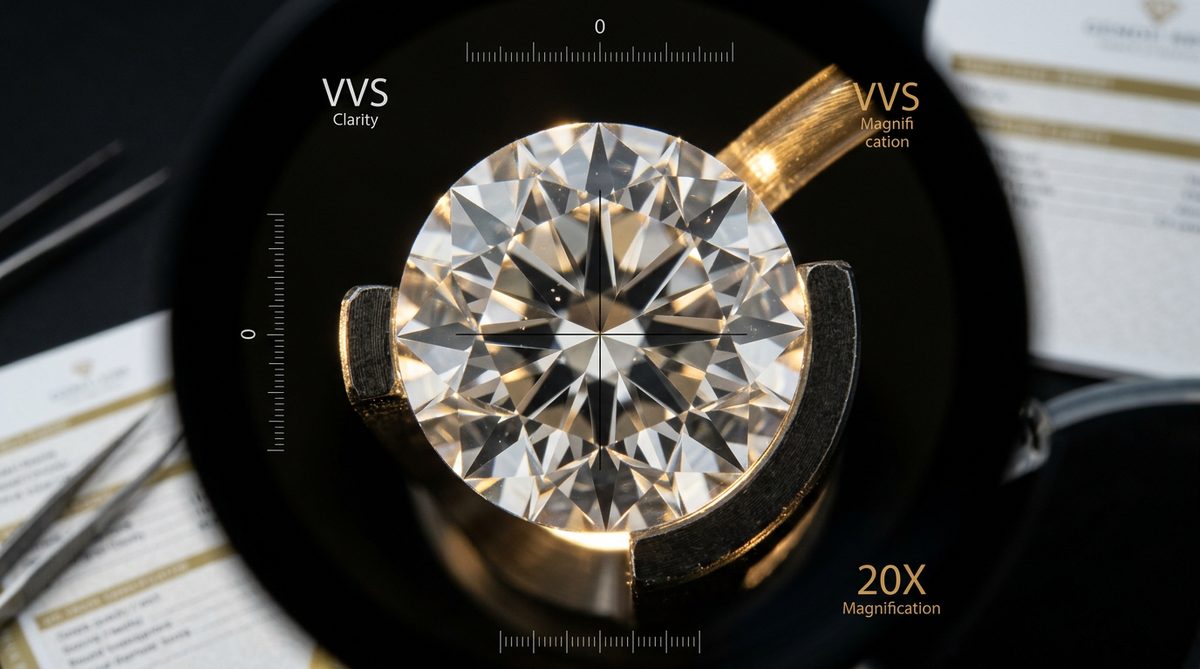
Diamond clarity grades are one of the most confusing parts of buying a diamond - and one of the most commonly overspent on. Here's what actually matters.
## What Is Diamond Clarity?
Clarity measures how many internal flaws (inclusions) and external blemishes a diamond has. The scale runs from Flawless (no inclusions visible under 10x magnification) down to Included (flaws visible to the naked eye).
The grades, from highest to lowest:
- **FL/IF** - Flawless / Internally Flawless
- **VVS1/VVS2** - Very Very Slightly included (very hard to find flaws under 10x)
- **VS1/VS2** - Very Slightly included (difficult to see flaws under 10x)
- **SI1/SI2** - Slightly Included (flaws visible under 10x, sometimes to naked eye)
- **I1/I2/I3** - Included (flaws visible to the naked eye)
## What Can You Actually See?
Here's the honest truth: with the naked eye (no magnification), you cannot see the difference between any of these grades:
- FL vs VVS1 vs VVS2 vs VS1 vs VS2
The inclusions in VS diamonds are invisible to the naked eye. You need a jeweller's loupe (10x magnification) to see them.
Even SI1 diamonds often look "clean" to the naked eye - especially in shapes like round or oval where inclusions can be hidden under the facet pattern.
## Where the Clarity Grades Actually Matter
**In round brilliant diamonds:** Facets hide inclusions well. VS2 and even SI1 can appear eye-clean.
**In emerald and asscher cuts:** These step-cut diamonds have large, flat facets that act like windows - inclusions are much more visible. Stick to VS1 or higher for these shapes.
**In oval, pear, and marquise:** Brilliant-cut shapes hide inclusions better. SI1 can often be eye-clean.
**In solitaire settings:** A single diamond with no side stones - any inclusions won't be hidden by other stones. Consider VS2 or higher.
**In halo or pave settings:** Many small stones surround the centre diamond. Focus budget on the centre stone; the setting hides a lot.
## The Price Trap
Here's what many buyers do: they pay for VVS1/VVS2 when they can't see any difference from VS2. On a 1-carat natural diamond, the jump from VS2 to VVS1 can be R20,000-R40,000 - for literally invisible differences.
That's money you could put toward a better cut (which IS visible) or a larger carat weight (which IS visible).
## Our Recommendation
**Smart buyers choose VS2 or SI1** for most shapes. The only exceptions:
- Emerald and asscher cuts: VS1 minimum
- Investment-grade diamonds: VVS1-VVS2 (for certification purposes)
- If you're particularly inclusions-averse: VS1 for peace of mind
**Never choose I1-I3** - inclusions are visible without magnification and can affect the diamond's structural integrity and brilliance.
## Compare Clarity at Diagem
Browse our certified diamonds and use the filter to compare different clarity grades side by side. Every stone is certified by GIA or IGI:
- [Natural Diamonds](/pages/natural-diamonds)
- [Lab-Grown Diamonds](/pages/lab-grown-diamonds)
- [Ask Our Experts](/pages/contact-us)
Related Reading
Ready to Find Your Perfect Diamond?
Diagem Diamonds has been South Africa's trusted direct diamond dealer for over 25 years — factory-direct pricing, GIA & IGI certified, with insured nationwide delivery.
- Browse Natural Diamonds — GIA & IGI certified, ethically sourced
- Explore Lab-Grown Diamonds — same brilliance, 50–70% less
📞 Call or WhatsApp David: +27 82 551 2103 — personal guidance, no obligation.