Lab-Grown Diamonds in 2026: Everything South Africans Need to Know
Natural diamond guide-price note: These prices are examples for information only, not live offers or guarantees.
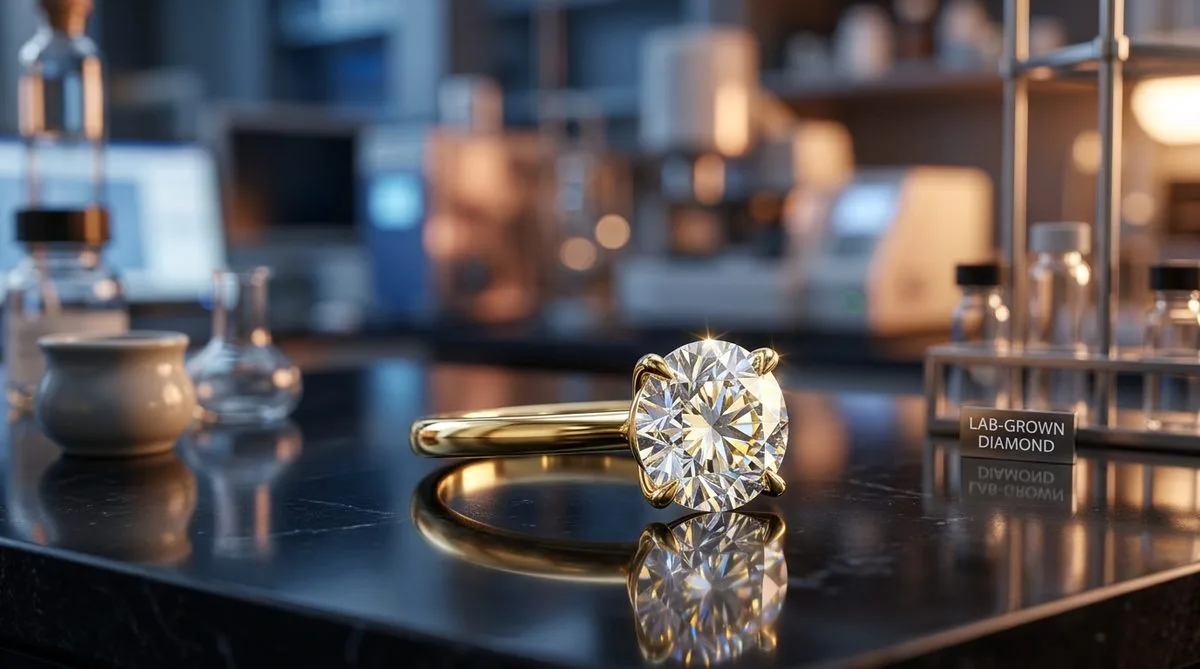
Let Me Be Straight With You About Lab-Grown Diamonds
I've been in the diamond business for over 25 years, and nothing has changed this industry quite like lab-grown diamonds. When they first appeared at scale, there was a lot of scepticism — including from me. Then I saw the technology mature, the prices drop, and the quality become genuinely exceptional. Now I sell them alongside our natural stones, and I'll tell you exactly why.
What Is a Lab-Grown Diamond?
A lab-grown diamond is not a simulant, not a fake, not cubic zirconia. It's a real diamond — chemically, physically, and optically. The only difference is that instead of forming over billions of years underground, it was grown in a controlled environment over a few weeks using either HPHT (high pressure, high temperature) or CVD (chemical vapour deposition) technology.
Put a lab-grown and a natural diamond side by side, and even a trained gemologist can't tell them apart without specialist equipment. That's not marketing. That's just the science.
How Are Lab-Grown Diamonds Made?
The two main processes are HPHT and CVD.
HPHT mimics the conditions deep within the earth — extreme heat and pressure applied to a carbon seed. CVD grows diamonds in a chamber using carbon-rich gas that deposits layer by layer onto a seed crystal. Both produce genuine diamonds. CVD has become the dominant method because it allows for larger, higher-quality stones at scale.
The result is graded by the same labs (IGI) using the same 4C criteria as natural diamonds. Every lab-grown stone I sell comes with proper certification.
Lab-Grown vs Natural — An Honest Comparison
Prices are indicative and subject to exchange-rate changes. Confirm your final quote with David.
Here's where I'll give you the picture most dealers won't.
Price: Lab-grown diamonds are typically 40-70% cheaper than comparable natural stones. For a 1.00ct G/VS2 excellent-cut diamond, you might pay R18,000-R30,000 for lab-grown versus about R63,920 for a comparable 1.00ct G VS2 natural round guide example. That's a real difference.
Appearance: Identical to the naked eye. End of story.
Value over time: This is where they differ significantly. Natural diamonds, particularly well-graded stones at 0.50ct and above, have historically held value and can appreciate. Lab-grown diamonds have been depreciating in resale value as production scales. If investment value matters to you, natural is the answer.
Environmental footprint: It's more nuanced than the marketing suggests. Growing diamonds requires significant energy — though some producers use renewable sources. Sourcing natural diamonds has its own environmental considerations. Neither option is straightforwardly "green".
Who Should Buy Lab-Grown Diamonds?
If your goal is to get the most impressive diamond possible within a given budget, lab-grown is genuinely compelling. Someone spending R50,000 can get a significantly larger, better-quality lab-grown stone than a natural diamond at the same price.
If resale value, investment potential, or the geological uniqueness of the stone matters to you — or if you simply want to know your diamond took a few billion years to form — natural is the right choice.
Most people I speak to are buying for sentimental reasons, not investment. For them, the question really comes down to: does it matter where it came from?
What Lab-Grown Diamonds Cost in South Africa in 2026
Prices are indicative and subject to exchange-rate changes. Confirm your final quote with David.
These are our direct prices — no retail markup:
0.50ct G/VS2 lab-grown solitaire ring: from R8,000–R15,000
1.00ct G/VS2 lab-grown in a quality setting: R20,000–R40,000
1.50-2.00ct lab-grown for bespoke design: R35,000–R70,000
Compare that to equivalent natural diamonds and the difference is significant. The quality of the stone is the same. The price story is very different.
My Honest Take After 25 Years
Lab-grown diamonds are a legitimate, high-quality option. I wouldn't sell them if I didn't believe that. For buyers who want maximum size and sparkle within a budget, they're genuinely the smarter choice right now.
What I'd caution is treating them as identical to natural diamonds in every respect. They're not. The price difference exists for a reason — scarcity and provenance. But if those things don't matter to you, don't let anyone pressure you into paying for them.
Have a look at our lab-grown diamond collection, or if you want to talk through what's right for you, WhatsApp me or call . I'll give you a straight answer.
Have questions? Chat with David, our diamond specialist — he responds within minutes.
Chat with David on WhatsApp